If you’re taking a daily stack of vitamins that looks more like a pharmacy receipt than a health habit, you’re not alone. The boom in personalized and bundled supplement packs has created a strange paradox: more pills, more money, more overwhelm—yet not always better health.
This guide walks you through a practical, step‑by‑step process to audit any bundled vitamin/mineral pack, cut the dead weight, and rebuild a lean, evidence‑based daily setup that fits your real needs and your budget.
Step 1: Admit the Problem—Why “More” Isn’t Working
Modern bundle packs promise “all‑in‑one” support for brain, gut, immunity, energy, sleep, stress, and performance—but often at the cost of 8–16 pills a day and $70–$150+ a month.[3][4]
Examples:
- Onnit Total Human day/night packs include 16 pills per day with multivitamins, omega‑3s, nootropics (Alpha BRAIN), and performance blends (Shroom TECH Sport) at about $4–$5 per day depending on retailer and subscription.[4]
- High‑end “performance” multis often add adaptogens, nootropics, and phytonutrients on top of basic vitamins and minerals, driving up both capsule count and cost.[3][4]
The problem: you’re paying for multiple goals at once—often in overlapping or redundant doses—and you can’t easily tell what’s actually doing anything.
Key red flags your pack is bloated
- You swallow more than 4–6 capsules per day just for general health (not counting specific medical prescriptions).
- The label reads like a novel: 30+ ingredients, multiple “proprietary blends,” and tiny milligram/microgram doses scattered across them.
- The price per day is higher than $2–$3 and the brand markets “total body optimization” rather than clearly defined outcomes.
Step 2: Pull Everything Out and Sort by Goal
Before you strip anything down, you need a clear view of what you’re actually taking. Lay all bottles or daily packs on a table and sort them into four piles:
1. Deficiency & basics (non‑negotiables)
- Core multivitamin/mineral
- Vitamin D3 (if low or limited sun)
- B12 and iron (if vegan/vegetarian or tested low)
2. Condition‑specific (doctor recommended)
- Supplements recommended by a clinician for a diagnosed issue (e.g., iron for anemia, high‑dose vitamin D for deficiency).
3. Performance & vanity
- Brain, energy, gym performance, metabolism, beauty/skin, hair/nail supplements.
4. Impulse & duplicates
- Anything you bought because of an ad, a friend’s recommendation, or a trend without a clear reason you’re still taking it.
For most people, the bloat lives in piles 3 and 4.
Step 3: Build a Minimal Baseline—One Product, Not Six
Your minimalist foundation should answer one question: What’s the simplest way to cover basic micronutrient insurance without mega‑dosing or overlap?
Option A: A true “minimal & essential” multi
Some brands explicitly design low‑complexity, essentials‑only formulas. For example:
- Vital Nutrients Minimal & Essential Daily Multivitamin – a one‑ or two‑a‑day multi providing core vitamins A, C, D3, E, B‑complex, zinc, selenium, and other essentials in capsule form.[1][2] A 180‑capsule bottle (up to 6 months at one‑a‑day) is often around $55–$65 at major retailers, working out to roughly $0.35 per day at a one‑capsule dose.[2][7]
Notice the difference versus pack‑style systems charging $4+ per day for similar or only slightly expanded micronutrient coverage.[3][4] That’s powerful price anchoring: once you see that coverage can cost ~$0.35/day, $5/day for basic vitamins suddenly looks bloated.
Option B: Targeted minimalist multi for your diet
If you eat plant‑based, minimalist doesn’t mean “everything”—it means exactly what your pattern tends to miss. For example:
- Complement Essential Vegan Multivitamin focuses only on typical plant‑based gaps: B12, D3, K2, omega‑3s (DHA/EPA), selenium, magnesium, zinc, and iodine.[8] It leaves out what you likely already get from food. A subscription is commonly around $1–$1.50 per day depending on plan.[8]
Compare that with an all‑in‑one pack that gives you every vitamin plus herbs, mushrooms, and nootropics—then charges you 3–4x as much. You’re paying for “more,” not “better.”
Step 4: Audit for Redundancy—Use the Label, Not the Marketing
Now grab your current bundle pack and a pen. You’re going to cross‑check it against your new minimalist baseline.
Label checklist (5‑minute exercise)
For each vitamin or mineral (A, C, D, E, K, B‑complex, zinc, magnesium, selenium, etc.):
- Write down how much you get from your baseline product (e.g., Minimal & Essential or Complement Essential).
- Write down how much you get from your bundle pack or other products.
- Circle anything where the total consistently exceeds 200–300% of Daily Value without a medical reason.
Many multis, including minimalist ones, already provide several hundred percent of some B‑vitamins and other micronutrients to ensure sufficiency.[1][2] When you stack another full multi or fortified powders on top, you can easily run into unnecessary excess for no added benefit.
Example: Vital Nutrients Minimal & Essential already provides over 400% DV of vitamin C and over 2,000% DV of B1 per capsule.[1][2] Add another “energy” multi or drink mix and you may simply be creating expensive urine.
Redundancy rules
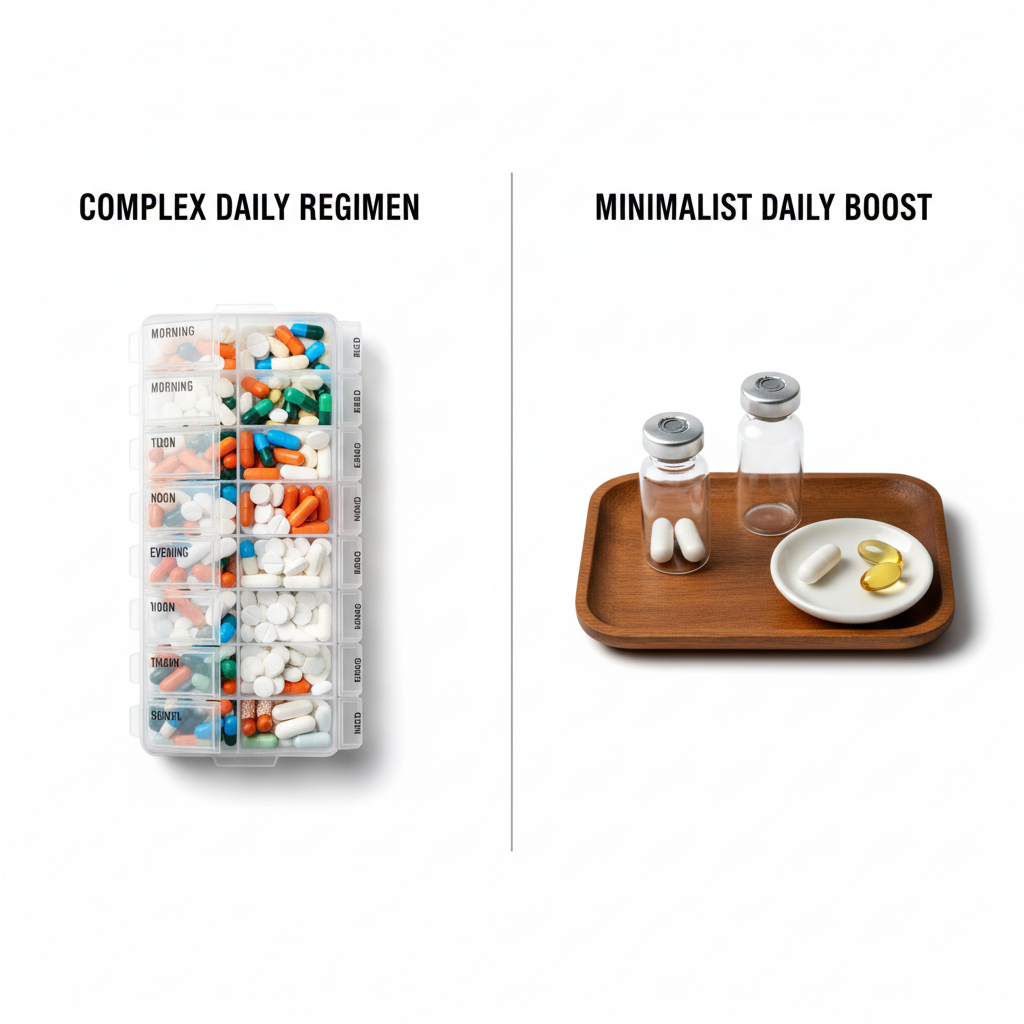
- One multi at a time. You rarely need two full multivitamins. Keep the simpler one and phase out the other.
- Don’t double up on “everything” powders + multi. If you use greens/reds powders, check their vitamin/mineral content; many are lightly dosed and can stay, but if they look like full blown multis, treat them as such.
- Be skeptical of overlapping blends. If your pack, pre‑workout, and “focus” pill all contain caffeine, B‑vitamins, and adaptogens, you’re stacking similar effects and costs.
Step 5: Decide What Earns Its Place (and What Gets Cut)
Now you’ll rebuild your daily setup from the ground up using a strict “must‑justify” rule.
Tier 1: Keep (baseline + medically indicated)
- One minimalist multi (e.g., Vital Nutrients Minimal & Essential or Complement Essential).[1][2][8]
- Anything your doctor specifically recommended for a lab‑confirmed issue (e.g., iron, high‑dose D3).
Tier 2: Keep only if you can name the benefit in one sentence
For each additional product, answer:
“In one sentence, what specific outcome am I expecting from this?”
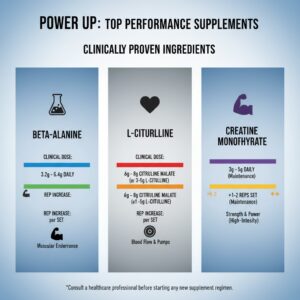
- “I use creatine for strength and power in my lifting program” is clear.
- “This pack supports total body optimization” is not.
If you can’t answer cleanly, move it to the “pause” pile for at least 30 days.
Tier 3: Cut or pause (high overlap, low clarity)
- Generic “energy,” “focus,” or “immunity” formulas that mainly duplicate your multi’s ingredients.
- Beauty blends that repackage biotin, vitamin C, and zinc you’re already getting from a multi or targeted product.[5]
- Day/night packs that just re‑split what could be a single daily multi and an optional magnesium or sleep aid.[4]
Step 6: Use Budget and Pill Count as Hard Constraints
To avoid creeping back into pill chaos, set two hard rules:
Rule 1: Daily budget cap
Decide your ceiling—for example, $1.50–$2.00 per day for all general‑health supplements. Minimalist multis like Vital Nutrients or focused vegan formulas like Complement Essential usually fit well below or within that limit, leaving room for one or two targeted add‑ons.[1][2][8]
Once you’ve seen that a basic multi can cost roughly $0.35/day and a more specialized vegan formula about $1–$1.50/day, paying $4–$5/day for a complex pack becomes much harder to justify unless it’s delivering very specific, noticeable benefits.[2][3][4][8]
Rule 2: Pill count cap
Set a health rule: no more than 4–6 capsules/tablets per day for routine use. This creates instant friction against massive bundles. If a product forces you to swallow 8 daytime capsules and 8 nighttime capsules just to “cover everything,” it fails this rule.[4]
Step 7: Test Changes One at a Time (So You Can Feel a Difference)
One of the biggest psychological traps of bundle packs is that you never really know what’s helping. You’re taking everything, so nothing can be clearly credited.
A simple 8‑week experiment
- Weeks 1–2: Switch to your minimalist baseline (one multi + essential doctor‑recommended items). Track energy, sleep, digestion, mood, and training performance.
- Weeks 3–4: Add one targeted product that truly earned its place (e.g., creatine, omega‑3, or a specific performance formula). Keep tracking.
- Weeks 5–8: Optional: test a different add‑on and compare. If you can’t feel or measure a difference, it probably doesn’t deserve a permanent spot.
This slow‑add approach uses the same rigor athletes and coaches apply when testing performance supplements; it turns you from a passive consumer of bundles into an active experimenter.
Where Minimalism Meets Personalization
Minimalist nutrition doesn’t mean ignoring individuality; it means using data and clarity before convenience and hype:
- Use lab work (vitamin D, B12, iron, etc.) and dietary patterns to choose a focused multi like Complement Essential if you’re plant‑based, or an essentials‑only multi like Vital Nutrients Minimal & Essential if you just want broad but simple coverage.[1][2][8]
- Lean on independent reviews and expert roundups of multis and packs to benchmark dosing, third‑party testing, and typical price ranges—many 2026 guides highlight that good multis don’t need exotic blends to be effective.[3][4]
- Reserve complex stacks (nootropics, adaptogens, performance blends) for genuinely high‑priority goals, not everyday background noise.
Your Next Move: A 20‑Minute Declutter Session
If you want an immediate, tangible win today, set a timer for 20 minutes and:

- Lay out every supplement you take.
- Sort into the four piles (basics, condition‑specific, performance/vanity, impulse/duplicates).
- Pick one minimalist baseline product to keep (or to switch to on your next order).
- Put everything in the impulse/duplicate pile into a “pause” box in a cupboard. Don’t throw it out yet—just take it out of your daily line of sight.
- Run the 8‑week experiment and only re‑introduce items that clearly earn their place.
The supplement industry makes money by selling you more. Your health and wallet benefit from you choosing less—but better. A lean, intentional daily stack built around a minimalist multi and a couple of targeted additions will almost always beat a bloated bundle pack you resent swallowing and can’t afford long term.