For years, families were told the same thing when they called an agency for a little help: “We have a 4‑hour minimum.” If you only needed someone to help Mom shower, prep lunch, and check medications, that minimum made care feel out of reach. In 2025, that’s quietly changing. A growing number of private-pay home care agencies are experimenting with short shifts, task-based visits, and micro‑coverage that let families buy help in smaller, more affordable chunks.[2][3][6]
Image suggestion: A warm kitchen scene where a caregiver helps an older adult with a short morning routine (tea, pills, light breakfast), visually conveying a 1–2 hour visit rather than an all-day shift.
The Big Shift: From “Half-Day or Nothing” to Flexible, Bite‑Size Care
Private-pay home care is booming, projected to grow from about $75.6 billion in 2021 to roughly $110 billion by mid‑decade, as more older adults insist on aging in place.[2][3] At the same time, agencies face rising wages, workforce shortages, and regulatory pressure to do more with less.[4][6][10] That mix of demand and pressure is forcing them to rethink the old “big block” scheduling model.
In 2025, three flexibility trends stand out:
- Short-shift models (1.5–3 hours) instead of 4‑hour minimums
- Task-based or ‘micro‑visit’ care (30–60 minutes focused on one job)
- Hybrid bundles combining a few longer visits with multiple micro‑check‑ins
Nationally, the median hourly cost of nonmedical in‑home care in 2025 is about $33/hour, with state medians running from $24 to $43 per hour.[7] That means rigid 4‑hour minimums can quickly turn into $3,000+ per month for families who only needed a fraction of that help. Micro‑visits change the math.
What “Micro‑Visits” Look Like in Real Life
Agencies label these new formats in different ways—“rapid response,” “check‑in care,” “task visits,” or “micro‑shifts”—but the structure is similar: brief, tightly defined visits at a slightly higher hourly rate than conventional 4‑hour blocks.
1. Morning‑Only Support: 90 Minutes Instead of 4 Hours
Imagine a daughter who works full‑time but worries about Dad’s mornings. She doesn’t need full personal care; she needs reliable, repeatable help with the hardest part of his day.
In many metro areas in 2025, a typical short‑shift option might look like this:
- Agency model: 1.5–2 hour minimum instead of 4
- Rate: $36–$40/hour for short shifts (vs. a $30–$33/hour standard rate)[5][7]
- Schedule example: 90 minutes, 5 mornings per week
Cost comparison (month estimate):
- Old 4‑hour minimum, 5x/week at $33/hr: about $2,860/month[7]
- New 1.5‑hour visit, 5x/week at $38/hr: about $1,235/month
Yes, the hourly rate is higher—that’s the price anchor. But the all‑in monthly cost drops by more than half. For many families debating “care vs. no care,” this is the difference between doing nothing and getting essential help in place early.
2. Task‑Based ‘Micro‑Coverage’ for One Risky Moment
Some agencies now sell pure task‑based micro‑visits in 30–60 minute units, especially in dense urban areas where aides can cluster visits. These are aimed at the one moment each day that creates the most risk: showers, transfers, or bedtime.
Typical 2025 urban example:
- Visit length: 45 minutes
- Focus: Shower and dressing, or medication setup and safety check
- Rate: $40–$50/hour equivalent, with a flat per‑visit fee (for instance, $35–$40 per 45‑minute visit)
Because agencies must cover travel time and rising wages—minimum wages in states like California sit at or above $16/hour in 2025, with local rates higher[10]—they compensate by pricing these micro‑visits at a premium per minute. But the total cash outlay can still be dramatically lower than a 4‑hour block.
3. “Care Bundles”: Mixing Long Visits with Micro‑Check‑Ins
Another 2025 trend is the hybrid bundle: one or two longer visits each week (for deep cleaning, bathing, detailed assessment), plus multiple brief check‑ins on other days. Agencies like hybrid models because they keep schedules predictable and improve retention, a hot priority in a labor market where home health and personal care aide jobs are projected to grow 17% from 2024 to 2034.[9]
Sample weekly bundle for a moderate‑needs senior:
- 2 × 3‑hour visits (meal prep, laundry, bathing, errands)
- 3 × 45‑minute micro‑check‑ins (medication, light snack, safety)
Estimated cost using 2025 median pricing:[7]
- Two 3‑hour visits at $33/hr: about $792/month
- Three 45‑minute check‑ins at a $40/hour equivalent: about $585/month
- Total: roughly $1,377/month
For context, that’s often far below assisted living base fees in many markets, while preserving maximum independence and letting families phase care up gradually.[2]
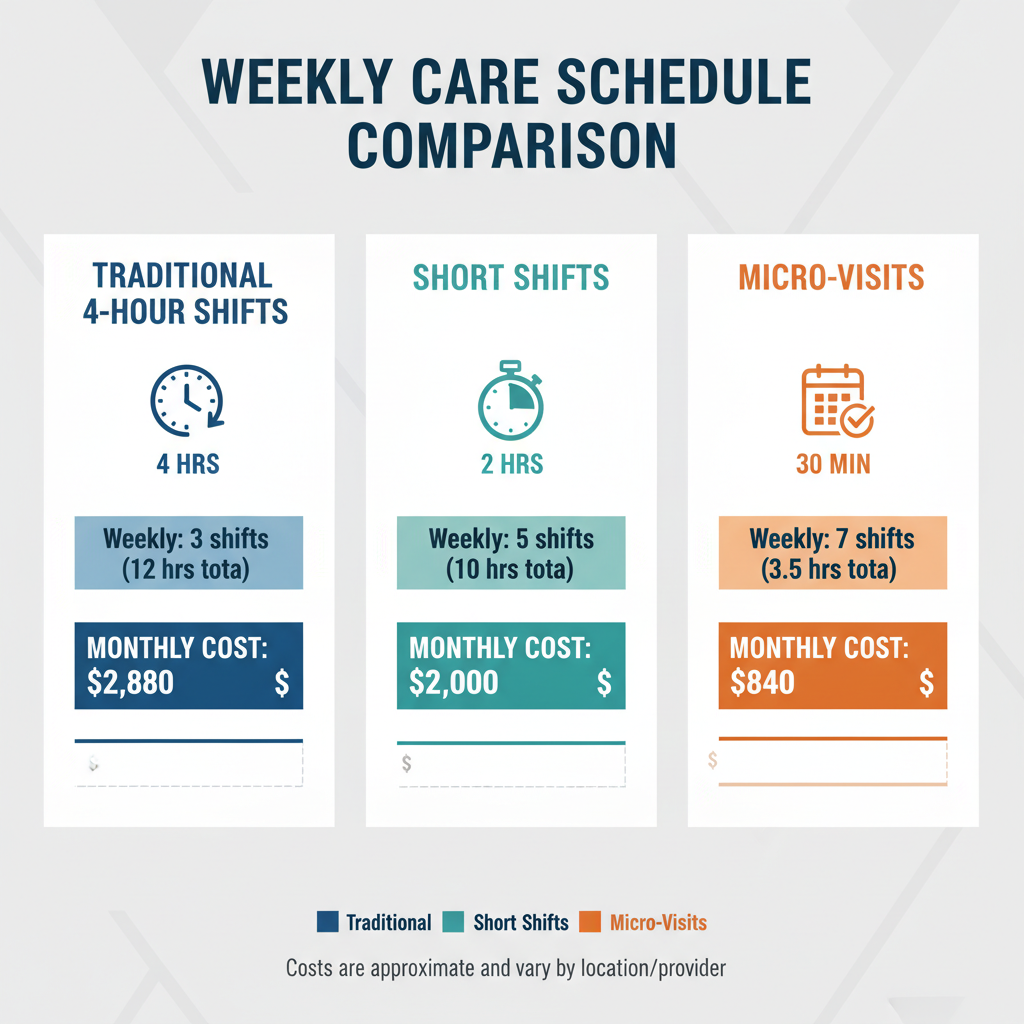
Image suggestion: Simple graphic comparing three weekly schedules—traditional 4‑hour blocks, short shifts, and micro‑visits—with total monthly cost bars beneath each option.
Real Services & Pricing Families Are Seeing in 2025
Because private-pay rates vary by city and state, it helps to anchor expectations with current benchmarks:
- National median for nonmedical in-home care (2025): about $33/hour.[7]
- Earlier national figures: In 2024, A Place for Mom reported a $30/hour national median; Care.com data put typical home health aide rates around $27/hour a few years earlier.[5]
- Common agency ranges: $24/hour on the low end in some states up to $40+ in higher‑cost metros in 2025.[7]
Agencies piloting short-shift and micro‑visit models usually follow this pattern:
- Standard blocks (3–4+ hours): around the local median ($28–$35/hour for many areas)
- Short shifts (1.5–3 hours): often +10–25% per hour vs. standard
- Micro‑visits (30–60 minutes): priced as a flat per‑visit fee, often equivalent to $40–$55/hour once travel is factored in
Industry guides highlight that about 63% of home care services are paid privately, which gives agencies the flexibility to offer these creative structures when families ask.[2] But here’s the catch: many agencies don’t advertise micro‑visits boldly on their websites. You usually have to ask directly.
How to Use Short Shifts to Stretch a Tight Care Budget
Instead of thinking, “We can’t afford care yet,” the right 2025 mindset is: “Where is one hour of help worth more than any other hour of the day?”
Step 1: Identify Your One or Two “Critical Hours”
Walk through an average day and flag where something regularly breaks down:
- Mornings: struggle with getting out of bed, showering, or medication
- Midday: no food, dehydration, or wandering
- Evenings: sundowning, confusion, or unsafe transfers
Those choke points are where a 45–90‑minute visit can prevent falls, emergency room visits, and caregiver burnout—often saving money against future hospital bills.[2]
Step 2: Call Three Agencies and Ask Very Specific Questions
Because agencies are under pressure from wage growth and staff shortages,[4][6][8] they are highly motivated to fill “gaps” in aides’ schedules with short visits—if the logistics work. When you call, ask:
- “Do you offer any short-shift or task-based visit options under 4 hours?”
- “What is the absolute minimum visit length if we schedule at the same time each day?”
- “Can we build a bundle with one longer visit and several short check‑ins?”
- “Are there off‑peak times (late mornings, mid‑afternoons) that are cheaper or easier to staff?”
The more predictable and convenient your requested window is for the agency, the more leverage you have to negotiate smaller units of care.
Step 3: Start Small—Then Let Results Justify Expanding
Agencies know that once a family sees the impact of even 90 minutes of structured help, they’re more likely to add hours later. That’s your advantage too: you don’t have to commit thousands of dollars to find out if home support helps. Try something like:
- 2 × 90‑minute morning visits per week for a month
- 1 × 45‑minute medication/safety check‑in on the hardest day of the week
Then review: Did falls, frantic calls, or missed medications go down? Did you sleep better or miss fewer work hours? Those soft benefits often justify slowly increasing coverage while staying well under the cost of facility care.[2]
Image suggestion: Photo of an adult child on the phone or video call with an agency care coordinator, reviewing a weekly calendar and building a mixed schedule of short and long visits.
Key 2025 Trends Working in Your Favor
Several broader industry shifts make this the right time to ask for more flexible arrangements:
- Explosive demand and private-pay growth: With private-pay home care expected to exceed $100 billion mid‑decade and around 63% of services funded privately, agencies are competing hard for sustainable, loyal family clients.[2][3]
- Technology and routing tools: Scheduling platforms now help agencies cluster micro‑visits in tight geographic zones, making 30–60‑minute stops more economical than in the past.[6]
- Labor pressure: With shortages and rising wages,[4][8][10] agencies are highly focused on “scheduling efficiency” and are more open to creative structures that keep aides busy in dense patterns.[3][6]
Put bluntly, agencies can no longer afford to turn away every family that can’t commit to 20 hours a week. The market is too big, and the tools are finally good enough to make small visits financially viable—if families push for them.
Next Steps: Turn This Trend Into a Concrete Plan for Your Family
To move from idea to action in the next 7 days:
- Make a one‑page list of your loved one’s riskiest times of day and the exact tasks that go wrong.
- Set a clear monthly budget you can live with (for example, “We can spend $700/month to test this for 90 days”).
- Call at least three local agencies and ask specifically about short shifts, micro‑visits, and bundles—do not assume their website tells the whole story.
- Choose the provider that’s most willing to pilot a small schedule and revisit it in 30–60 days based on results.
If you wait until you can afford a perfect 8‑hour coverage day, you may be waiting until after a crisis. 2025’s shift toward micro‑visits and flexible private-pay models gives you permission to start smaller, sooner—protecting your loved one’s safety and your own sanity, without committing to more care than you can handle.

Call to action: Before the week is over, pick one high‑risk hour in your loved one’s day and get quotes for covering just that window. You may be surprised how much protection a single well‑placed micro‑visit can buy—at a price your family can actually sustain.