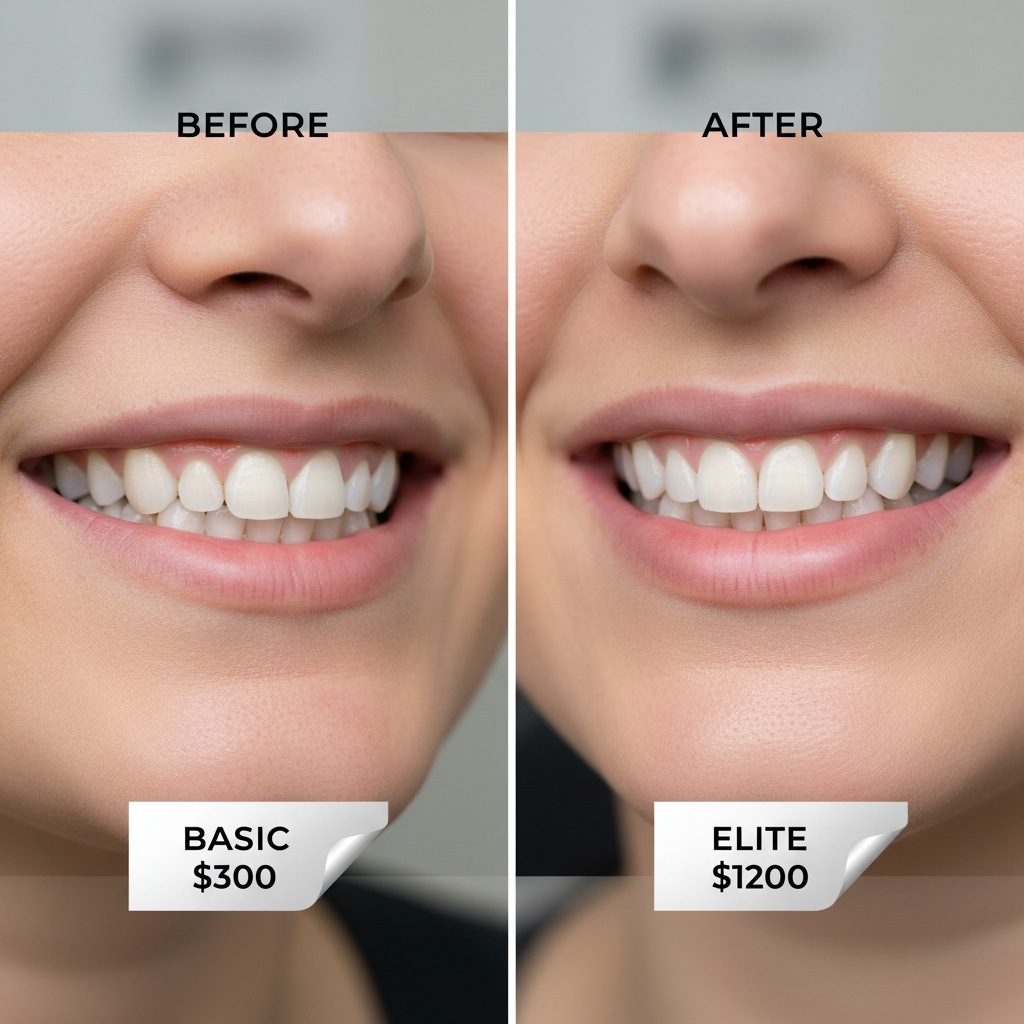
If you’ve requested a few quotes for laser gum contouring, the price difference can be shocking—one clinic offers a full smile reshape for a few hundred dollars, while another wants a few thousand for what sounds like the same thing. They are not the same thing.
This guide shows you how to decode cheap vs premium laser gum contouring: what really drives cost, when it’s smart to pay more, and when a lower fee is perfectly acceptable.
Why the Same “Laser Gum Contouring” Can Cost $300 or $3,000
Across U.S. cosmetic practices, cosmetic gum reshaping often falls between about $500–$3,000 per procedure, with lasers usually priced at the higher end of that range.[5][6] Some orthodontic and periodontal practices list $200–$400 per tooth or $500–$3,000 total depending on how many teeth are involved and how complex the case is.[1][5] In high-cost cities like Boston, laser gum contouring may reach $1,800–$4,200 per arch and $300–$800 per tooth, around 15–25% above the U.S. average.[3]
So why can quotes be so far apart?
- Scope: One or two teeth vs a full arch or full smile design.[1][3]
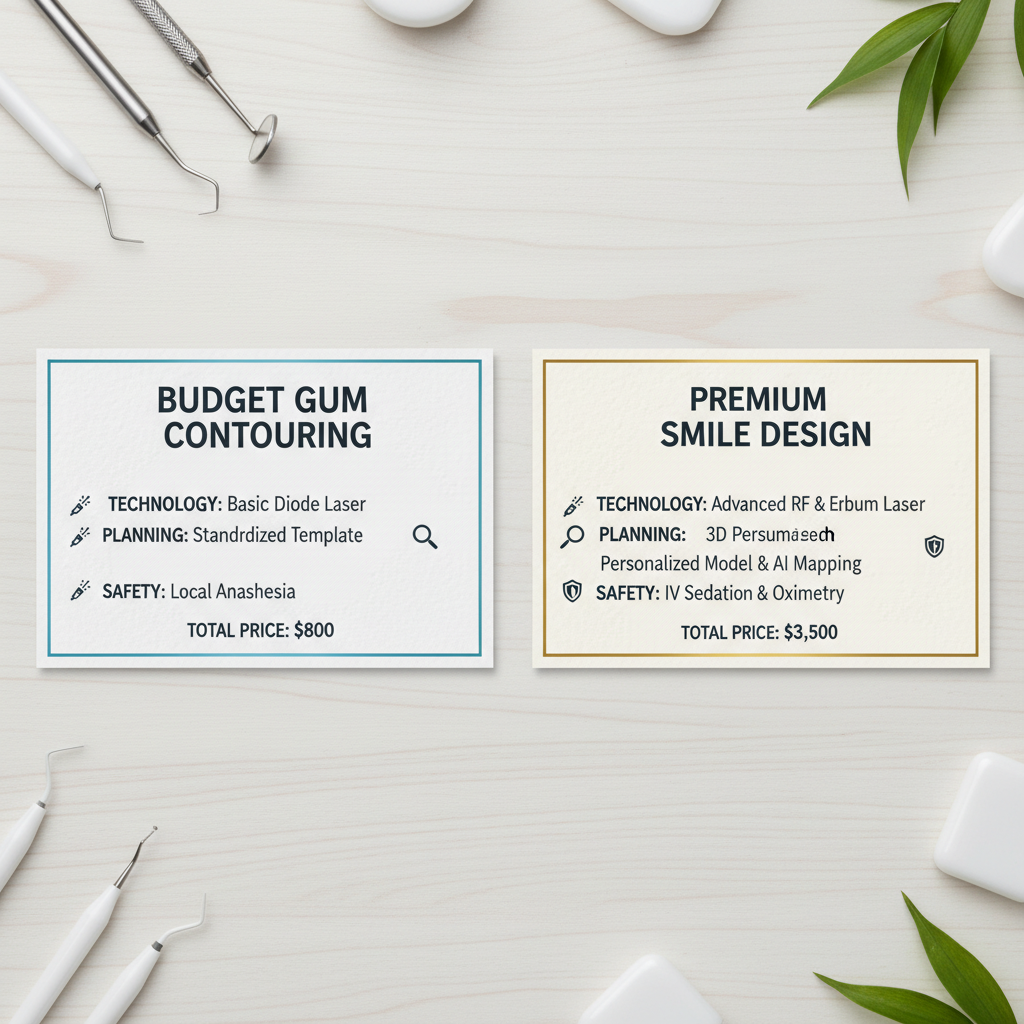
- Technology: Entry-level diode laser vs premium platforms like Waterlase or LANAP-certified systems.[1][3]
- Expertise: General dentist doing occasional cosmetic work vs a cosmetic or periodontal specialist with advanced training and 10–20+ years’ experience.[3]
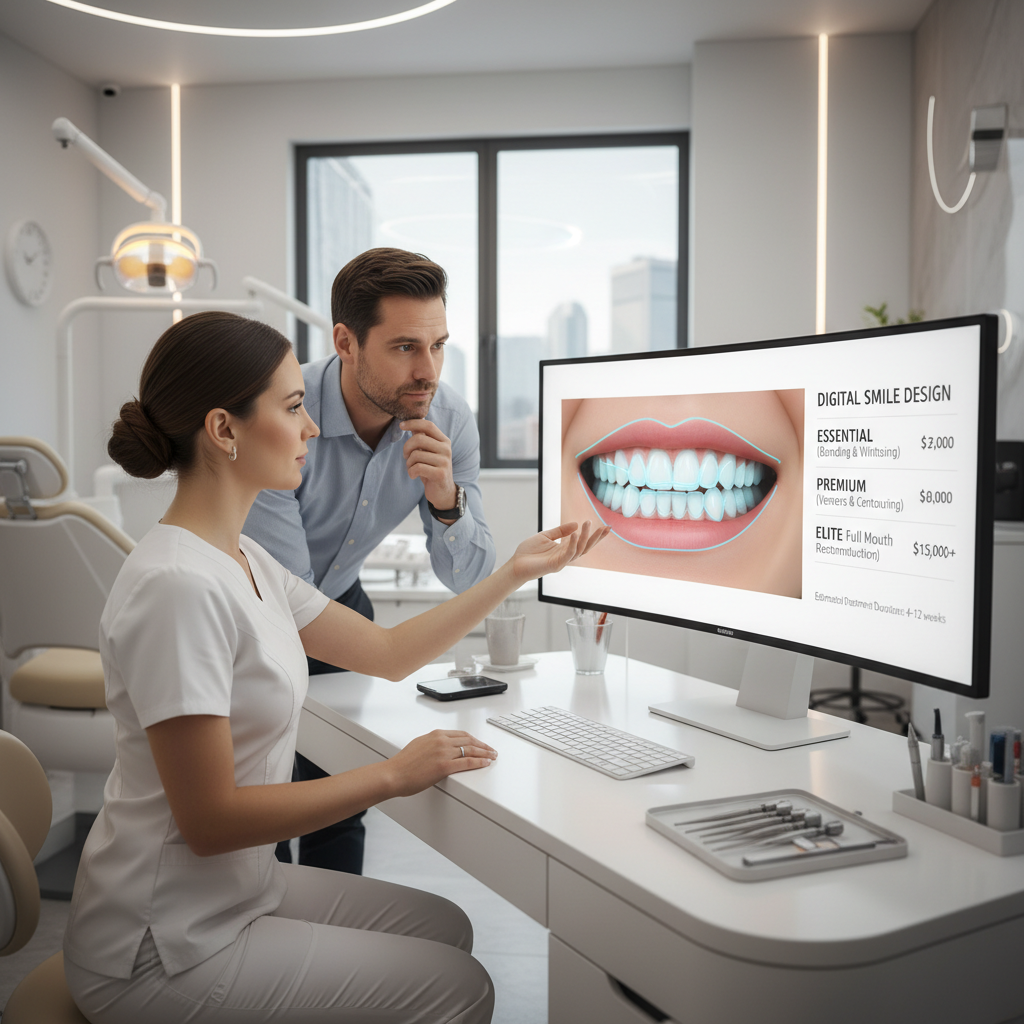
- Planning: Basic visual trimming vs full digital smile design, photo analysis, and 3D scans.[3]
- Location: Major metros and prestige districts (e.g., Boston’s Back Bay at $2,000–$3,800 per arch) vs suburban or regional practices.[3]
Understanding which of these you’re paying for is the key to a smart decision.
Cheap Clinics: When Low Prices Are a Smart Win
What “Budget” Laser Gum Contouring Usually Looks Like
At the lower end, you’ll often see offers like $50–$350 per tooth for simple gum reshaping at general cosmetic offices.[4] Some practices quote $200–$300 per tooth or around $500–$800 for minor smile line adjustment.[1][4][5] These lower fees are typical when:
- You only need a small adjustment around 1–3 teeth.
- The dentist uses a basic diode laser—cheaper to own, so cheaper to bill.
- There is minimal digital planning (photos and mirrors rather than full 3D smile design).
- The case is mostly cosmetic trimming, not complex tissue recontouring.
When a Lower Fee Is Perfectly Fine
Choosing a cheaper clinic can be reasonable (and strategic) if:
- You only see mild gum asymmetry on one or two teeth.
- No one has diagnosed gummy smile from skeletal or lip causes (which may require orthognathic surgery or Botox, not just laser).
- You are not combining this with high-end veneers or a full smile makeover.
- The dentist still provides before/after photos, clear consent forms, and post-op instructions.
In these situations, paying $1,800+ per arch at a boutique cosmetic center can be overkill when simple laser contouring in a modest practice would be visually indistinguishable.
Red Flags in “Too Cheap to Be True” Offers
However, extreme bargain pricing—especially in markets where averages are closer to $1,000–$2,800 per arch[3][5]—deserves scrutiny. Watch for:
- No comprehensive exam or periodontal charting before treatment.
- Limited or no explanation of risks (root exposure, sensitivity, relapse).
- No credentials in cosmetic dentistry, periodontics, or laser systems.
- Single flat fee for “as much as needed” contouring with no documented plan.
Laser gum contouring is usually not medically necessary, so most insurance won’t pay.[3][5] That makes it tempting for some clinics to compete on price alone. Your job is to separate a fair deal from unsafe corner-cutting.
Premium Clinics: What the Extra Money Actually Buys You
Price Anchors: What Counts as “Premium”?
Premium cosmetic practices commonly quote ranges like:
- $1,000–$2,800 per arch as a national baseline.[3][5][6]
- $1,800–$4,200 per arch in high-cost metros such as Boston.[3]
- $300–$800 per tooth when detailed sculpting is required around individual teeth.[3]
Some international cosmetic clinics position themselves as “value-premium,” such as U.K. practices charging around £220 for single-tooth laser contouring including consult and aftercare.[7] That still reflects careful planning and follow-up, just in a different market.
Technology Level: Lasers Aren’t All the Same
Premium quotes often reflect substantial investment in high-end laser systems, which can cost six figures and require dedicated training. While individual clinic models vary, many cosmetic and periodontal centers highlight platforms such as:
- Erbium or erbium-chromium lasers (e.g., Waterlase-type systems) offering precise soft-tissue sculpting with less heat.
- LANAP-certified lasers in practices that also treat periodontal disease with minimally invasive protocols.[2][3]
Higher-end lasers are associated with more precise cutting, less collateral damage, and quicker healing, which practices use to justify premium fees.[1][2][3]
Dentist Expertise and Digital Planning
Expert cosmetic and periodontal providers usually justify their higher prices with:
- Advanced training: Fellowship training, laser certification (Waterlase, LANAP), and 10–20+ years’ focused experience in smile aesthetics often command 20–40% higher fees.[3]
- Digital smile design: 3D imaging, calibrated photography, and mockups to predict and preview your gum line before they ever touch tissue.[3]
- Integrated cosmetic plan: Coordinating gum contouring with veneers, orthodontics, or whitening, which can dramatically affect final aesthetics.[5][6][8]
In other words, you’re not just paying for minutes with a laser—you’re paying for a low-risk, predictable result that won’t sabotage thousands of dollars in future cosmetic work.
Safety Protocols: Where It’s Worth Refusing the Cheapest Option
What Safe, Modern Protocols Look Like
Better clinics will bake safety into the fee. Expect to see line items or bundled value such as:
- Comprehensive diagnostic work: consultation, digital X‑rays, and possibly 3D scans, often adding $150–$300 but critical for identifying bone levels and biologic width.[3]
- Controlled anesthesia and comfort: local anesthetic and, when needed, light sedation, which may add $75–$200.[3]
- Structured follow-up: at least one review visit ($100–$150) to check healing and make micro-adjustments.[3]
- Documented sterilization and PPE protocols: especially important with laser plume and blood aerosols.
While these extras raise the bill, they significantly reduce risk of infection, over-trimming, or uneven healing—issues that are far more expensive and stressful to fix later.
When a Premium Fee Is the Safer Bet
Paying toward the top of the range is usually justified if:
- You have a gummy smile across multiple teeth or both arches, with more than 2–3 mm of tissue being adjusted.
- You’ve had previous gum surgery or existing crowns/veneers around the area.
- You’re combining gum contouring with a high-value cosmetic plan (veneers, aligners, whitening) where any misstep affects a $5,000–$20,000 investment.[5][6][8]
- You have a history of gum disease or complex medical factors, where integration with periodontal care and laser gum therapy (often $1,000–$4,000 per quadrant for disease management)[2] is important.
Here, a rock-bottom cosmetic-only fee is not a bargain—it’s a risk multiplier.
How to Compare Two Very Different Quotes (Step-by-Step)
1. Normalize the Scope
Ask each clinic to state clearly:
- How many teeth will be treated?
- Is the fee per tooth, per arch, or full mouth?
- Is consultation, imaging, anesthesia, and follow-up included?
A $600 quote for three teeth (effectively $200 per tooth) may be comparable to a $1,500 quote for a full arch in another clinic.[1][3][4]
2. Probe the Technology
Ask:
- “What type of laser do you use for gum contouring?”
- “Is it also used for periodontal therapy or just simple cosmetic trimming?”[2]
You don’t need the fanciest machine for mild cosmetic tweaks, but for large, visible reshaping, better platforms and experienced operators can be worth the surcharge.
3. Check Credentials and Volume
Questions to ask:
- “How many cosmetic gum contouring cases do you complete per month?”
- “Do you have before/after photos of similar cases?”
- “Do you have any advanced training in cosmetic dentistry, periodontics, or laser systems?”[3]
Social proof matters—if a dentist has a portfolio of well-documented cases, a waitlist, and strong word-of-mouth, paying more can buy you peace of mind.
4. Factor Financing and Total Cost of Ownership
Premium clinics often pair higher fees with more flexible financing such as CareCredit or LendingClub, with typical down payments around $200–$500 and monthly payments of $75–$200.[3] This can make a safer, more predictable outcome accessible even if the sticker price is higher.
Action Plan: Decide if You Need “Premium”… or Just “Good Enough”
If You’re Price-Sensitive but Want Good Results
- Limit treatment to the most visible teeth in your smile line.
- Look for a dentist offering $200–$400 per tooth with clear before/after photos and at least a few years of cosmetic experience.[1][4]
- Accept simpler planning (photos vs full 3D) but insist on a proper exam and follow-up visit.
If You’re Planning a Full Smile Makeover
- Anchor your expectations near the $1,000–$3,000 per arch range, more in elite urban markets.[3][5][6]
- Actively seek out clinics that combine digital smile design, veneers/aligners, and laser contouring under one plan.[5][6][8]
- Be willing to go “premium” on the gums now to avoid costly revisions later.
Your Next Move (Do This Before Booking)
- Shortlist 2–3 clinics: one budget, one mid-range, one premium.
- Book consultations and bring the same set of questions about scope, tech, and follow-up.
- Compare not just price, but planning quality, comfort with the dentist, and photographic proof.
If you do this, you’ll stop wondering whether you’re being overcharged and start choosing intentionally: pay more when safety and long‑term aesthetics demand it, and confidently pick a cheaper option when your case is simple.
Call-to-action: Before you say yes to any quote, schedule at least one additional consultation with a clinic that offers digital planning and can show you similar before/after photos. Use their plan and price as a benchmark—if your original quote looks suspiciously cheap or unjustifiably expensive in comparison, you’ll know it’s time to walk.