If you’ve ever hovered over the “Subscribe” button on AG1 or Huel Daily Greens and wondered, “Is this really smarter than a cheaper green scoop from Amazon?”, you’re exactly who this breakdown is for.
Instead of asking “What’s the best greens powder?”, we’re going to ask a far more useful question: “How much real‑world benefit do I get per dollar—from AG1, from Huel, and from a solid budget blend?”

The 30‑Second Snapshot: Who Wins on Value?
To keep this practical, think in cost per serving and what you actually get back in convenience, quality, and peace of mind.
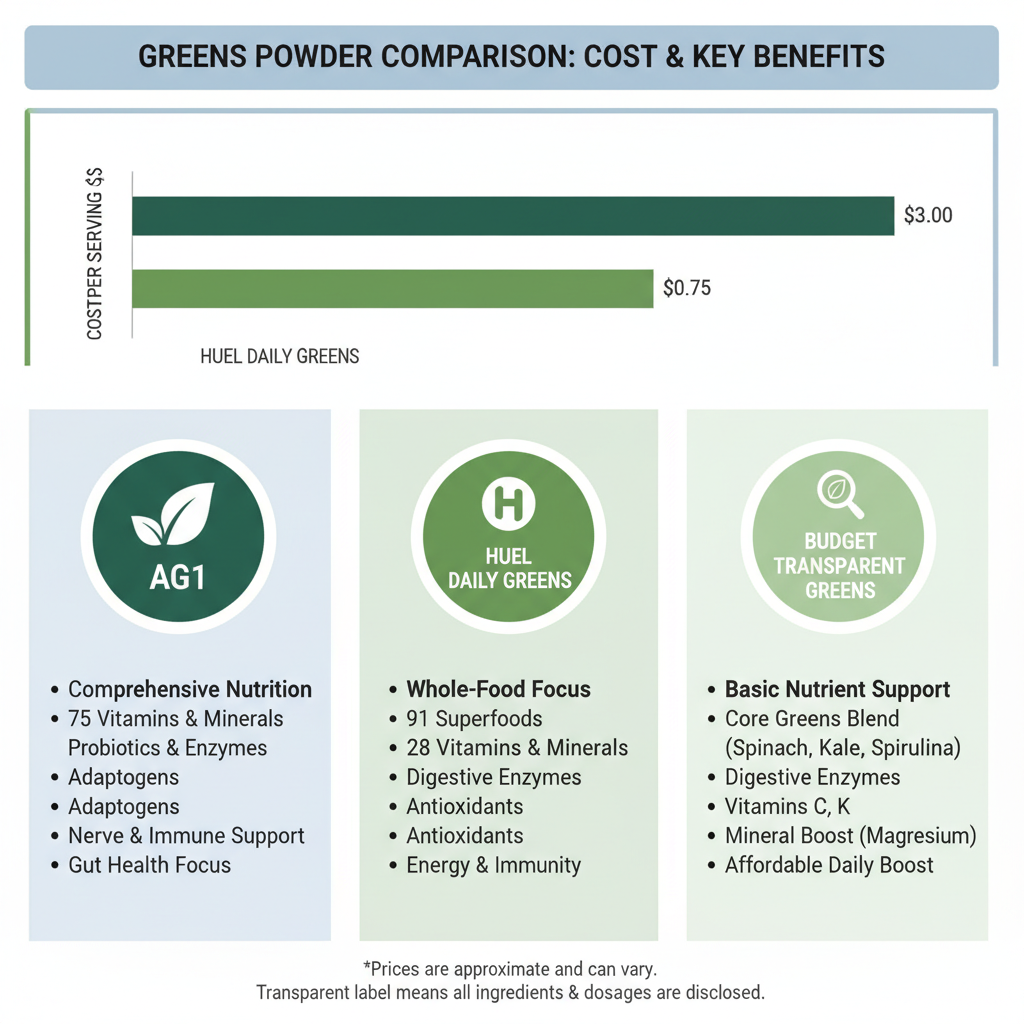
| Product | Approx. cost/serving (2025) | Best for |
|---|---|---|
| AG1 Next Gen (formerly Athletic Greens) | ~$3.30 one‑time / ~$2.60–$2.90 subscription | “All‑in‑one” convenience + NSF Certified for Sport[3][2] |
| Huel Daily Greens | ~$1.50/serving or ~£45 for 30 servings[1][4] | Multivitamin replacement on a budget[2][4] |
| Transparent Labs Prebiotic Greens | ~$1.20–$1.40/serving (typical online pricing)[2] | Gut‑focused, fully disclosed doses[2] |
AG1 is clearly the price anchor—by far the most expensive in most expert roundups, at around $3.30/serving for a one‑time bag of 30[3]. Huel deliberately undercuts that with a roughly $1/day saving per serving compared to Athletic Greens, thanks to bags that are over $30 cheaper for similar serving counts[4]. Transparent Labs and other disclosed‑label blends then squeeze in below Huel as the value plays[2].
Step 1: Decide What You’re Really Buying
Are You Buying Nutrients… or a System?
AG1 is marketed less as “green powder” and more as a daily health protocol: one scoop intended to replace your multivitamin, probiotic, and several other supplements in one hit[1][2]. Each serving includes 70+ ingredients, a 7–10 billion CFU probiotic dose, and about 2 g of prebiotic fiber[2]. It is also NSF Certified for Sport, giving athletes confidence in purity and banned substance testing[2][7].
Huel Daily Greens goes for breadth: about 91 ingredients in an 8.5 g scoop and a more complete spread of essential vitamins and minerals than AG1, including some nutrients AG1 under‑delivers or omits (like vitamin D and iron)[2][4]. But its probiotic dose and fiber content are lower and less central to the product’s pitch[1][2].
Transparent Labs Prebiotic Greens flips the script: it is not trying to be your all‑in‑one. Instead, it focuses on clinically relevant amounts of prebiotic fibers and gut‑supporting plant ingredients, with full label transparency—you see exactly how many grams of each ingredient you’re getting[2]. That makes it attractive to lifters, biohackers, and anyone who distrusts “kitchen sink” proprietary blends.
The Proprietary Blend Penalty
Both AG1 and Huel rely heavily on proprietary blends: they list long ingredient panels but do not disclose the exact dose of each one[2]. For evidence‑driven buyers, this is a red flag: you’re paying premium prices without knowing if most actives are present at meaningful levels.
Transparent Labs and similar budget‑plus brands win big here. Their fully open labels make it possible to compare formula doses against actual research, not just marketing copy[2].
Step 2: Run a Simple Cost‑Per‑Benefit Check

Benefit Bucket #1: Foundational Nutrition (Micronutrients)
If your goal is “cover the bases” for vitamins and minerals, Huel Daily Greens is surprisingly strong for the price. Analyses find it delivers more total micronutrients than AG1, including some that AG1 lacks or under‑doses[2][4]. At roughly $1.50 per serving[1][4], its cost‑per‑nutrient win is obvious.
AG1, by contrast, is less complete on some vitamins and minerals and may require you to keep vitamin D and iron supplements around if your diet is low in those[2]. From a pure multivitamin replacement standpoint, AG1 is often less efficient per dollar than Huel.
Benefit Bucket #2: Gut Support (Probiotics & Prebiotics)
This is where AG1 earns some of its premium. It includes roughly 7.2–10 billion CFU of probiotics per serving, plus about 2 g of prebiotic fiber and other gut‑supporting compounds[2]. For many users, the perceived benefits—better regularity, less bloating, improved digestion—are front and center in reviews and expert rankings that place AG1 at or near the top for gut‑supportive greens[3][7].
Huel Daily Greens, while it includes some bacterial cultures and fibers, does not match AG1’s probiotic dose or emphasis[1][2]. If digestive health is your primary goal, it becomes harder to justify AG1’s premium only if you are willing to stack a separate, targeted probiotic with a cheaper greens or multivitamin instead.
That is where Transparent Labs Prebiotic Greens excels: it provides higher, transparent doses of prebiotic fibers and polyphenol‑rich greens for the money, but typically without probiotics[2]. You’d then pair it with a standalone probiotic of your choice—giving you more control and often a lower combined cost than AG1.
Benefit Bucket #3: Testing, Trust & Risk Reduction
For competitive athletes and very risk‑averse consumers, third‑party testing is a direct benefit. AG1 carries NSF Certified for Sport status, meaning every batch is independently tested for quality, purity, and banned substances[2][1]. That costs money—and is part of why AG1 can credibly charge above $3 per scoop in some markets[3].
Huel Daily Greens does not currently match AG1’s level of third‑party sport certification, focusing instead on broader nutritional completeness and affordability[2][4]. Transparent Labs and some other mid‑range brands emphasize in‑house quality control and some third‑party testing, but not always the strict sport‑specific certifications[2].
If a failed doping test or contaminated supplement would be catastrophic for you, AG1’s certification premium may simply be a cost of doing business.
Step 3: Match the Product to Your Personality (and Budget)
If You’re a Convenience‑Maximizer
You want one scoop, once per day, and you’re done. In that case, paying a premium for an “all‑in‑one‑ish” formula can make sense.
- AG1 is the obvious choice: multivitamin‑style coverage, gut support, adaptogens, antioxidants, and NSF Certified for Sport in one serving[2][3][7]. If you’re replacing a multivitamin (~$0.30/day), a probiotic (~$0.50–$1/day), and perhaps an antioxidant blend, the effective “net” premium over separate supplements shrinks.
- Cost reality check: even if AG1 saves you the cost of several separate products, you are still likely paying more than building a smart stack yourself—what you are really buying is simplicity and trust.
If You’re Budget‑Conscious but Still Health‑Serious
This is where Huel Daily Greens and mid‑range blends shine.
- At around £45 / ~$55 for 30 servings (~$1.50/day)[1][4], Huel undercuts AG1 by roughly $1–$1.50 per serving while providing a more complete vitamin/mineral spread[2][4].
- If you mainly want to “top off the tank” nutritionally and don’t care about maxed‑out probiotics, Huel gives you a rational cost‑per‑benefit profile.
Other editorial reviews in 2025 frequently highlight AG1 alternatives with lower cost‑per‑serving and solid formulas, ranking products like Transparent Labs Prebiotic Greens as top value picks when gut health is the priority and methodical dosing matters[2][5][8].
If You’re an Analytical Tinkerer or Biohacker
You probably won’t be happy with proprietary blends at any price. In that case:
- Choose a transparent greens formula like Transparent Labs Prebiotic Greens and pair it with a separate, evidence‑based probiotic and a good multivitamin.
- Your total daily cost often lands in the $1.50–$2.00 range, still below AG1 in most scenarios, while giving you precise control of each component[2].
How to Build Your Own “Cost‑Per‑Benefit” Stack in 10 Minutes

1. Set a Hard Budget Ceiling
Decide what you are truly willing to spend per day on this habit: $1, $2, or $3+. Anything above $2/day should feel premium and justify itself clearly in your life.
2. Pick Your Non‑Negotiables
Choose up to two must‑have benefit buckets from this list:
- Micronutrient “insurance policy” (vitamins/minerals)
- Gut health (probiotics/prebiotics)
- Third‑party testing and sport certification
- Time‑saving convenience (single scoop, no stacking)
For example:
- If you pick gut health + sport certification, AG1 is the straightforward—but expensive—answer[2][3].
- If you pick micronutrients + budget, Huel Daily Greens or another mid‑range greens plus a $10/month generic probiotic may win on value[2][4][8].
3. Compare Effective Daily Cost, Not Just Sticker Price
Do a quick napkin calculation:
- AG1: ~$3.30/day one‑time ($99/30)[3], dropping slightly on subscription.
- Huel Daily Greens: ~$1.50/day (~£45/30 servings)[1][4].
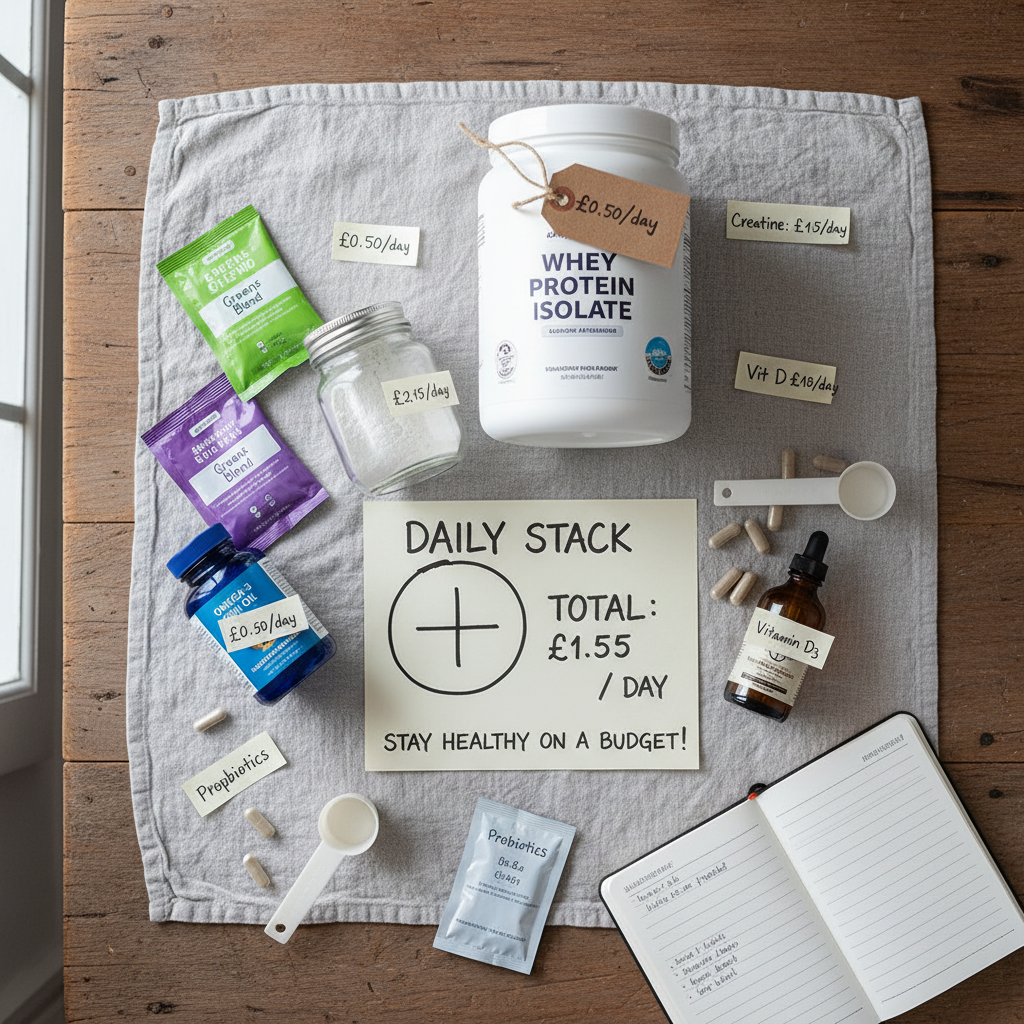
- Transparent label greens + separate probiotic + basic multi: commonly lands around $1.50–$2.00/day in total[2].
Multiply by 365. A $1/day difference is $365 per year. If AG1 versus Huel or a DIY stack feels like a close call on benefits, that annual number often makes the decision obvious.
4. Stress‑Test for Consistency
The best greens routine is the one you won’t abandon in month three. Consider:
- Taste and texture: AG1 is often described as smooth and mildly tropical, with easy mixing and no clumps[1]. Huel has a bolder, fruit‑forward profile (apple, pineapple, mint, lime) with a slightly thicker or grittier consistency some love and some dislike[1].
- Preparation friction: If a product is fussy to mix or unpleasant to drink, the cost‑per‑benefit effectively skyrockets because you skip more days.
So… AG1, Huel, or Budget Blend?
Use this simple rule of thumb:
- You value iron‑clad testing, elite convenience, and a strong probiotic hit: AG1 is defensible despite the price. Think of it as paying a “certainty tax” for high trust and low decision fatigue[2][3][7].
- You want multivitamin‑style coverage without a luxury price tag: Huel Daily Greens gives more micronutrient breadth per dollar and still feels premium compared to cheap supermarket greens[2][4].
- You enjoy tinkering and squeezing every drop of value from your budget: a transparent greens powder plus a separate probiotic and basic multivitamin usually beats both AG1 and Huel on cost‑per‑benefit—at the cost of a slightly more complex routine[2][8].
The real FOMO risk in 2025 isn’t “missing out on AG1”—it’s sleepwalking into a $1,000/year auto‑renew that delivers no more benefit than a leaner, smarter $1.50/day stack you’d actually stick with.
Action step: Before you buy anything, write down your budget, your top two benefit priorities, and whether you’ll realistically keep up a more complex stack. Then choose AG1, Huel, or a transparent budget blend because it fits that plan—not because an influencer made it look good in a shaker bottle.