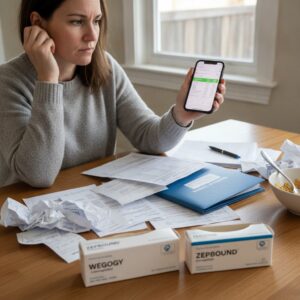
The center of gravity for prescription weight‑loss care is quietly shifting from your local doctor’s office to your laptop—and Big Pharma is now steering the ship. If you’ve been thinking about GLP‑1s like Wegovy or Zepbound, the real question in 2025–2026 isn’t just *what* drug to take, but *which telehealth funnel* you’re willing to step into.

The Big Plot Twist: Pharma Is Now Co‑Branding With Telehealth
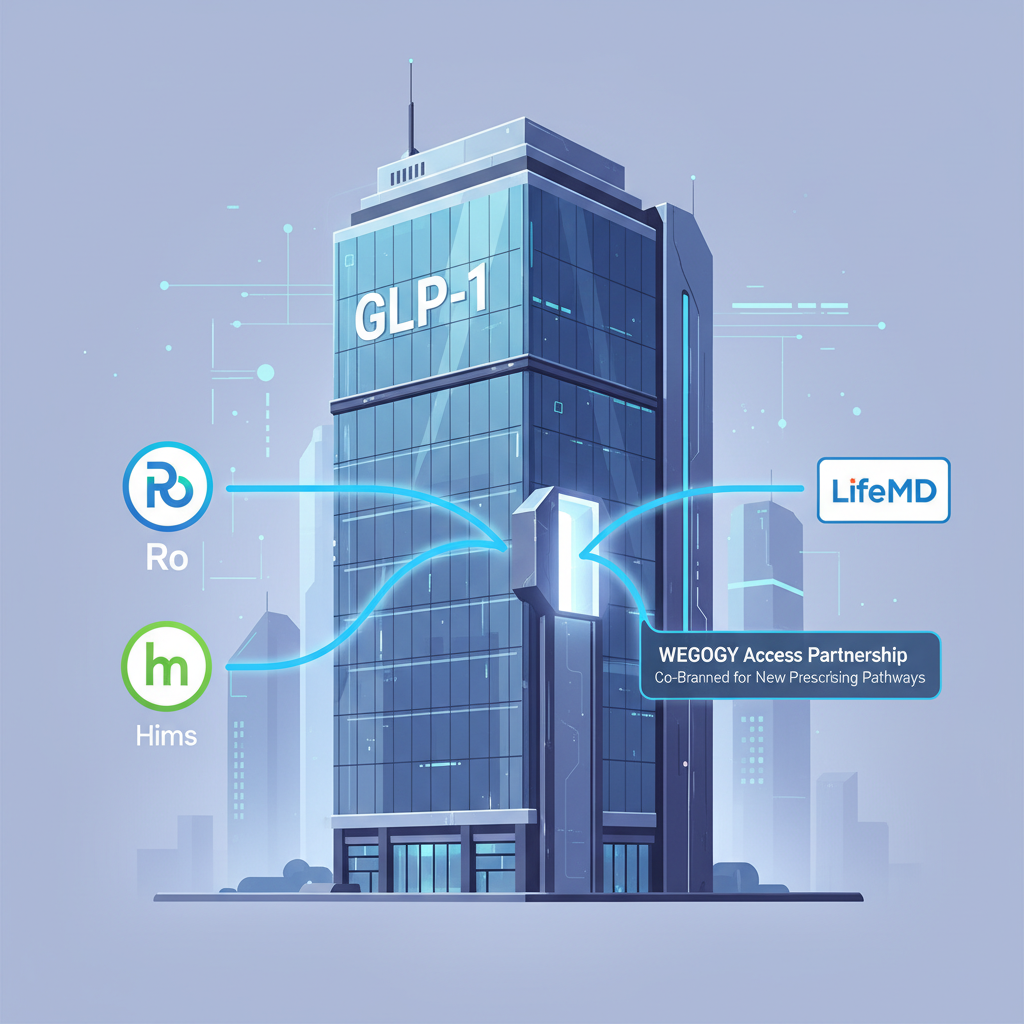
For years, GLP‑1 telehealth was dominated by startups pushing compounded semaglutide as a workaround to high prices and supply issues. That era is ending. In April 2025, Novo Nordisk formally partnered with GLP‑1 telehealth platforms including Hims & Hers, Ro, and LifeMD to deliver FDA‑approved Wegovy directly to patients via its NovoCare Pharmacy and CenterWell Specialty Pharmacy.[1][2][5]
Self‑pay patients can now get authentic Wegovy for a flat $499/month through these partners, with all doses available for home delivery.[1][2][5] This is a major price reset in a market where GLP‑1s have often run over $1,000/month out of pocket.[6]
Why this matters:
- Telehealth becomes an official sales channel for branded GLP‑1s, not just a gray‑area workaround.[2][4]
- Manufacturers bypass PBMs (pharmacy benefit managers) and negotiate directly with patients via D2C telehealth funnels.[2][4]
- Compounded alternatives are being squeezed as pharma undercuts prices and leans on FDA safety messaging.[2][3]
Example: Hims & Hers + Wegovy Bundle
Hims & Hers now offers a Wegovy bundle that includes the medication plus a membership with 24/7 care, clinical support, and nutrition guidance starting at $599/month.[5] That price effectively anchors the market: Novo’s $499 cash price for Wegovy itself,[1][2] plus ~$100 for wraparound coaching, messaging, and brand experience.
Meanwhile, Lilly Is Building Its Own Ecosystem Around Zepbound
On the Eli Lilly side, the strategy looks slightly different: rather than only plugging into existing telehealth brands, Lilly has built its own ecosystem through LillyDirect and partnered services.
One notable example: Goodpath partnered with GiftHealth, LillyDirect’s pharmacy provider, to streamline access to Zepbound (tirzepatide) for eligible members.[3] Members go through Goodpath for whole‑person care—weight management, joint pain, sleep, mental health—while GiftHealth handles the GLP‑1 dispensing.[3]
What stands out with the Goodpath/GiftHealth model:[3]
- Whole‑person program (AI‑supported coaching, kits, side‑effect management) wrapped around Zepbound.
- Physician guidance and adherence support baked into the service, not just a one‑off prescription.
- Positioned as a long‑term care pathway, not a quick “lose 20 lbs before summer” fix.
While public list prices for Zepbound remain high, broader policy changes are starting to chip away at that. A recent federal agreement has been framed as potentially dropping GLP‑1 cash prices to roughly $300–$400/month for some patients, with Medicare/Medicaid users paying as little as $50/month after coverage.[6] That’s not universal yet—but it signals where the market is heading.
Retail & Pharmacy Giants Are Quietly Entering the Game
It’s not just startups and pharma anymore. Traditional retail players are turning GLP‑1 telehealth into a loss‑leader to capture long‑term customers.
Walgreens, for example, now markets online GLP‑1 weight‑loss treatment with promos like starting at $149/month for the first two months (time‑limited through April 2026).[7] That teaser price exploits anchoring: once you’ve paid $149 and seen results, you are far more likely to accept a higher ongoing medication cost.
Combine that with in‑house virtual visits and automatic prescription fulfillment, and retail pharmacies effectively become GLP‑1 subscription platforms with a pharmacy attached.

What This New Landscape Means for You: Safety, Pricing, and Access
1. Safety: Branded vs. Compounded Is No Longer a Close Call
Before these partnerships, many online clinics leaned heavily on compounded semaglutide due to shortages and cost. That brought FDA warnings and lawsuits over unapproved formulations and impurities.[2][3] With Novo and Lilly now making branded products more accessible via telehealth, the safety calculus shifts:
- Branded GLP‑1s (Wegovy, Zepbound) now available at structured cash prices through vetted channels (Hims, Ro, LifeMD, LillyDirect partners).[1][2][3][5]
- Compounded options look less attractive as the price gap narrows and legal scrutiny rises.[2][3]
- Telehealth platforms are increasingly integrating pharmacy and prescriber systems (e.g., CenterWell) for tighter monitoring and adherence.[1]
2. Pricing: “Sticker” vs. “Real” Cost
The GLP‑1 price story now has three layers:
- List prices often above $1,000/month.[6]
- Manufacturer telehealth cash offers: Wegovy at $499/month for self‑pay via NovoCare/CenterWell and partner platforms.[1][2][5]
- Program bundles: Hims & Hers Wegovy + membership at $599/month;[5] retail promos like Walgreens’ $149/month starter offers.[7]
Psychologically, you’re being anchored at the $1,000+ mark, nudged toward feeling like $499–$599 is a bargain—even though this is still a major recurring expense. On the other end, short‑term discounts (e.g., $149 for two months)[7] create urgency and FOMO: “If I don’t sign up now, I’ll lose this deal.”
3. Access: Geography Matters Less, Digital Literacy Matters More
Telehealth + pharma partnerships mean that, as long as you:
- Live in a state where the telehealth provider is licensed, and
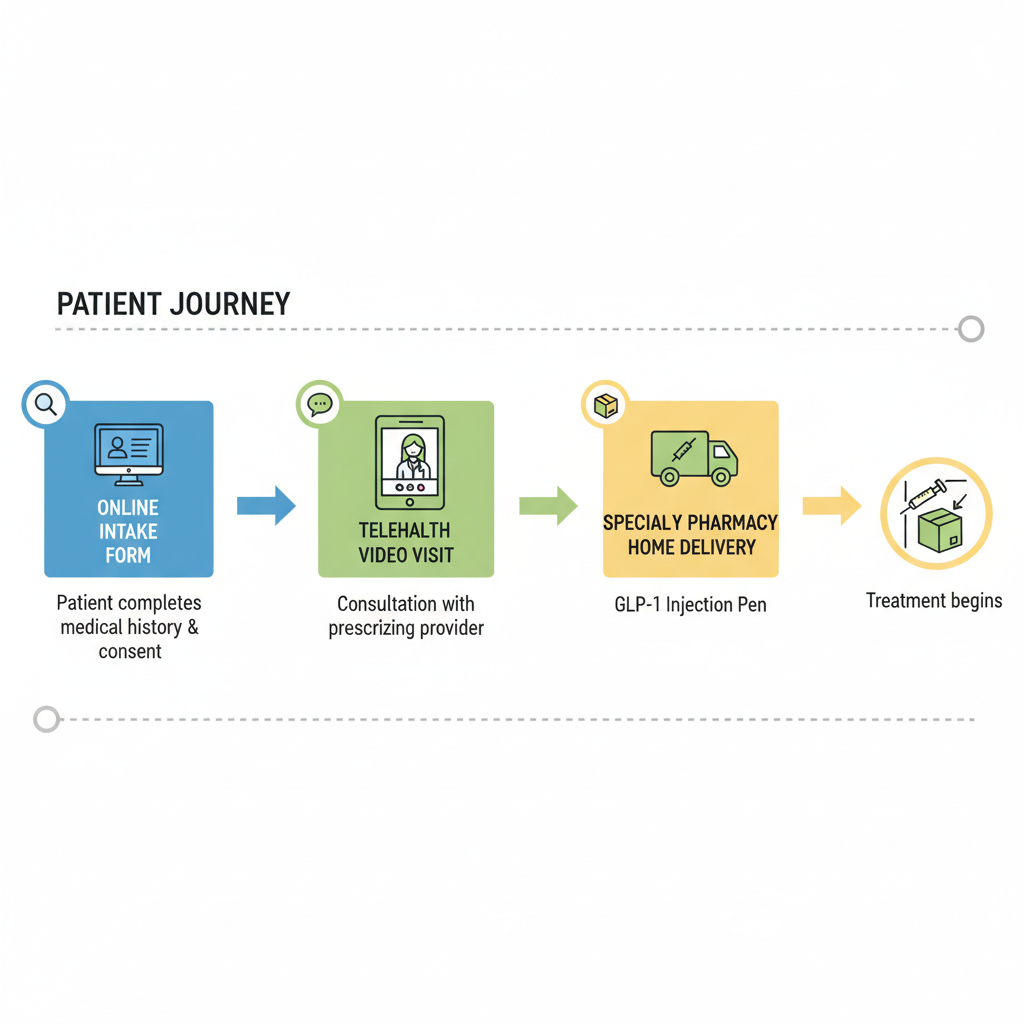
- Can navigate an online intake form and video call,
you can usually reach a GLP‑1 prescriber without ever meeting them in person.[1][2][4][5] For many patients who face stigma or lack local obesity specialists, that anonymity is a feature, not a bug.[1][2]
A Clear Framework for Choosing the Right Online GLP‑1 Program
Step 1: Decide Which “Ecosystem” You Want to Live In
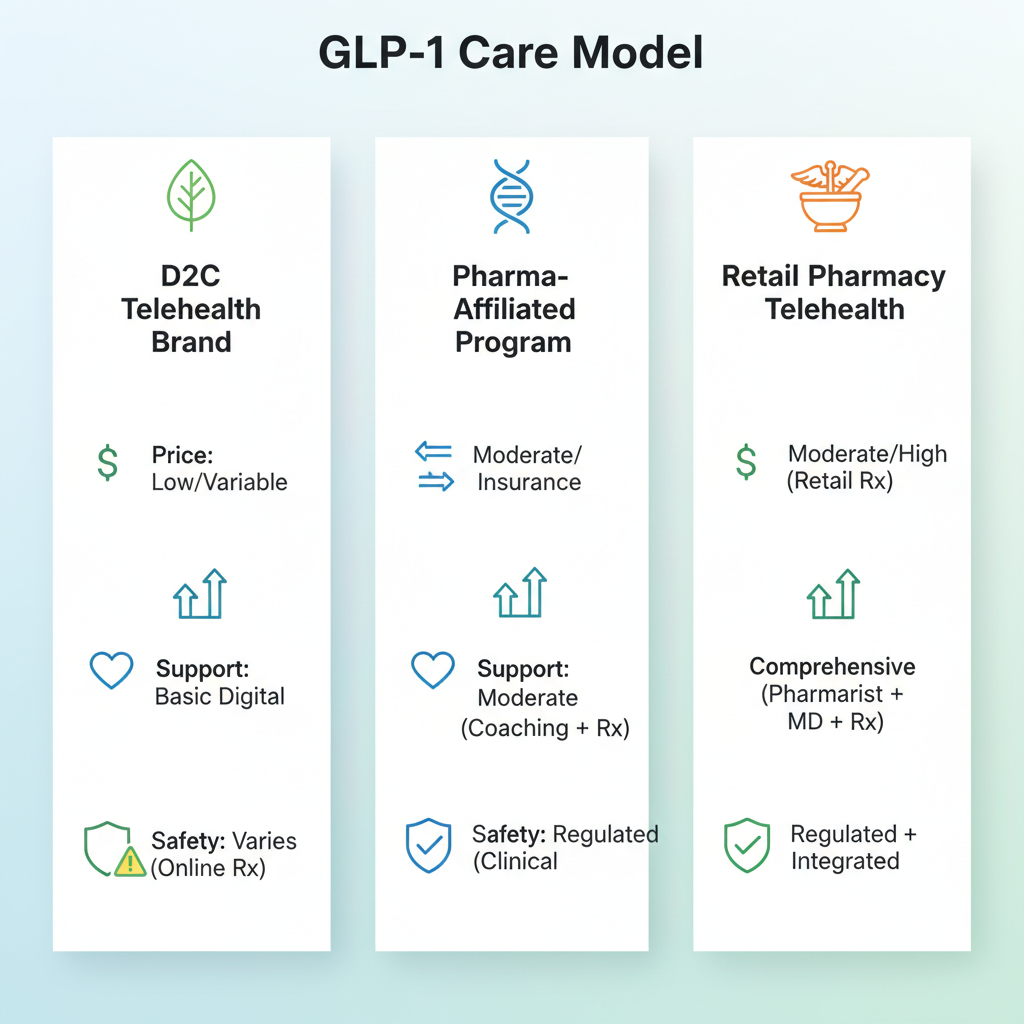
You are effectively choosing an ecosystem, not just a prescriber. Broadly:
- Pharma‑partner telehealth brands (Hims, Ro, LifeMD) – Best if you want transparent pricing on Wegovy, quick onboarding, and a modern app experience.[1][2][5]
- Pharma‑owned/affiliated ecosystems (LillyDirect + partners like Goodpath) – Strong for those seeking long‑term, whole‑person care around Zepbound.[3]
- Retail pharmacy programs (Walgreens virtual GLP‑1 care) – Attractive if you already use their pharmacy and want integrated refills plus occasional promo pricing.[7]
Step 2: Compare True Monthly Cost (Not Just the Headline Number)
When you evaluate programs, list out:
- Medication cost (e.g., Wegovy at $499/month cash via Novo’s program).[1][2]
- Platform fees or membership (e.g., extra ~$100 for Hims & Hers Wegovy bundle).[5]
- Visit fees (initial consults, follow‑ups).
- Lab costs (A1C, lipids, etc., if not covered by insurance).
Then ask: “What am I really paying per month over 12 months?” This avoids being overly influenced by initial promo months or teaser rates.
Step 3: Vet Safety Signals and Clinical Depth
Look for:
- Explicit use of branded GLP‑1s (Wegovy, Zepbound) vs. vague “semaglutide injections” from unnamed pharmacies.[2][3]
- Clear integration with recognized pharmacies (e.g., CenterWell, GiftHealth).[1][3]
- Side‑effect protocols, tapering plans, and titration support; some platforms are now using personalized titration tools to reduce GI issues.[9]
Step 4: Decide How Much Support You Actually Need
Telehealth programs fall on a spectrum:
- Minimalist: You get a prescription and basic check‑ins.
- Mid‑range: Messaging access to clinicians, nutrition content, and occasional coaching (e.g., many D2C bundles).[5]
- High‑touch: Full care teams, AI‑supported programs, and holistic coaching (e.g., Goodpath’s multi‑condition model).[3]
Pay for the level of support that will realistically keep you adherent for 12–24 months. GLP‑1s are long‑term therapies; churn after three months is where people lose both money and progress.

How to Act Now Without Getting Swept Up by Hype
If you’re considering GLP‑1 treatment in this new telehealth + pharma era, here is a lean, practical action plan you can follow today:
Immediate Next Steps
- Clarify your priority: Is it lowest cash price, maximum support, or most flexible ecosystem?
- Shortlist 2–3 programs across different models (e.g., one pharma‑partner telehealth like Hims/Ro, one LillyDirect‑adjacent like Goodpath, and one retail option like Walgreens).[1][3][7]
- Run the 12‑month math for each, including membership and labs—not just the headline medication price.
- Check eligibility: BMI criteria, comorbidities (e.g., cardiovascular disease, where Wegovy now also carries a CV risk‑reduction indication).[1][2]
- Book one consult with the program that best aligns with your budget and support needs, but resist signing long‑term commitments until you’ve experienced the first month.
The window right now is unusual: manufacturers are undercutting their own legacy pricing, telehealth platforms are competing aggressively, and regulators are tightening the screws on compounded knockoffs. That combination creates a brief period where motivated, informed patients can lock in safer, more affordable GLP‑1 access—if they choose their online pathway wisely.